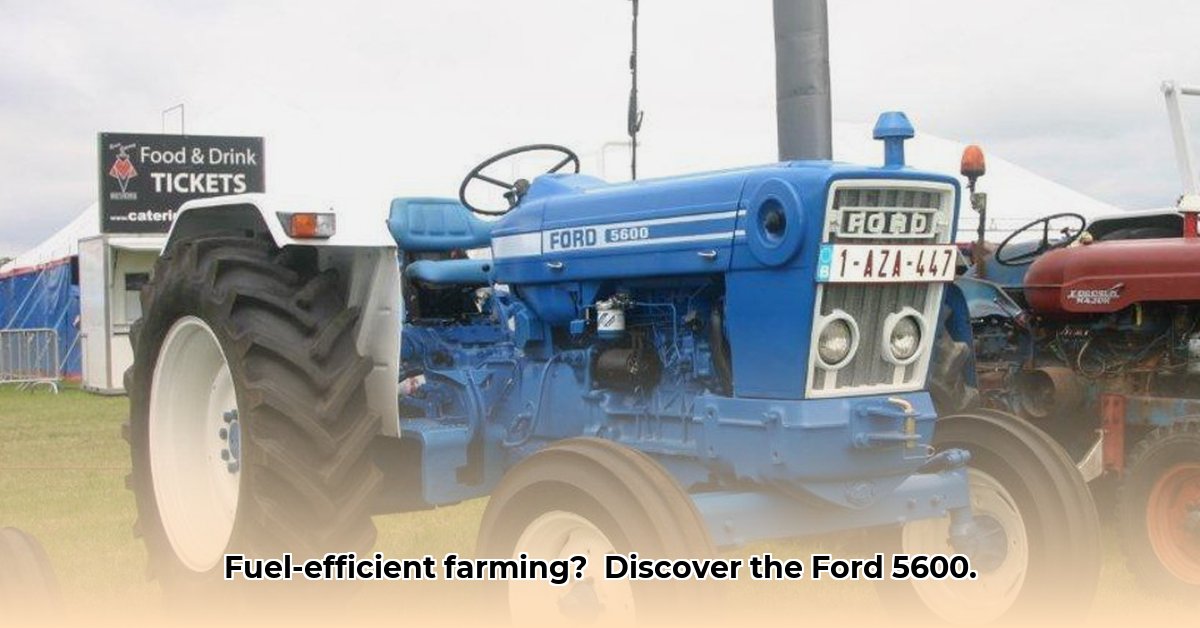
The Ford 5600 tractor, a mainstay of farms in the late 1970s and early 1980s, offers a unique lens through which to examine the evolution of sustainable agricultural practices. This detailed analysis explores its fuel efficiency, comparing it to modern tractors, and considers its historical context within the broader narrative of sustainable farming. We'll uncover surprising insights into how design choices from decades past can inform contemporary approaches to environmentally conscious agriculture. For more on fuel tank options, see fuel tank info.
Power and Performance: A Balanced Approach
The Ford 5600 boasted 69 gross horsepower and 65 net horsepower—modest compared to today's behemoths. This raises a crucial question: Did farmers of that era prioritize fuel efficiency over sheer power, implicitly embracing a form of sustainability? Or did the tractor's design simply reflect the technological limitations and fuel costs prevalent at the time? Analyzing this requires examining the economic realities and environmental concerns of the 1970s. Were farmers already intuitively responding to resource scarcity, even without the explicit framework of modern sustainable agriculture?
Fuel Efficiency: A Design Priority
Fuel conservation was central to the Ford 5600's design. Unlike modern tractors with massive fuel tanks, the 5600 offered varying tank sizes, and even allowed for the addition of an auxiliary tank. This points to a proactive fuel management strategy, a direct response to the economic pressures of the era. Could this approach—precise fuel management and strategic tank sizing—serve as a model for contemporary farmers seeking to improve their operational sustainability? The answer potentially lies in re-evaluating our consumption habits and utilizing existing resources more efficiently.
Operator Comfort: A Human-Centered Approach to Sustainability
Beyond mechanical specifications, the Ford 5600 prioritized operator comfort. Features like optional climate-controlled cabs weren't mere luxuries; they likely enhanced operator alertness and productivity. A comfortable, well-rested operator is a more efficient one, suggesting a holistic approach to farm sustainability that encompasses both the machine and the human element. This often-overlooked aspect highlights the interconnectedness of worker well-being and operational efficiency.
A Historical Context: Sustainability in the 1970s
To fully grasp the Ford 5600's place in the sustainable agriculture narrative, we must consider the socio-economic and environmental context of the 1970s. What environmental regulations were (or weren't) in place? What were the prevailing concerns regarding environmental impact? Understanding these historical factors provides critical context for interpreting the tractor's design choices and assessing its sustainability in comparison to modern standards. This historical perspective broadens our comprehension of how our approaches to sustainable farming have evolved.
Comparing Then and Now: Data Challenges and Opportunities
Direct comparisons between the Ford 5600 and modern tractors are hampered by incomplete data. Emission data from the 1970s is often sparse, hindering a precise evaluation of the tractor's historical environmental footprint. This highlights the challenges inherent in assessing the long-term sustainability of older machinery. Further research is needed to provide a comprehensive understanding of the Ford 5600's overall environmental impact. Future studies should prioritize a rigorous data collection process to address the gaps in existing information.
Lessons from the Past: Applying the Ford 5600's Wisdom
Despite its age, the Ford 5600 offers valuable lessons. Its design choices reflect an ongoing—and enduring—dialogue about balancing productivity and sustainability. The tractor's relatively moderate horsepower, fuel-saving features, and focus on operator comfort collectively suggest a more integrated and holistic approach. Can these design principles inform contemporary sustainable farming practices? The legacy of the Ford 5600 prompts us to reconsider our priorities in agricultural engineering and operational efficiency. Its enduring legacy challenges us to reexamine our approach to technology's role in sustainable agriculture.
Comparative Analysis: Ford 5600 vs. Modern Tractors
| Feature | Ford 5600 (1970s) | Modern Tractor (Example) | Key Differences and Implications |
|---|---|---|---|
| Horsepower | ~65 net hp | Often 250+ hp | Significantly higher power in modern tractors, affecting fuel consumption and emission levels. |
| Fuel Efficiency | Designed for fuel economy; various tank options | Varies greatly; less design emphasis on fuel efficiency compared to other features. | Different design priorities, impacting fuel usage and overall operational sustainability. |
| Technology | Relatively simple mechanical systems | Advanced electronics, GPS guidance, etc. | Modern technologies enhance precision farming but also increase initial costs and potential for higher energy consumption. |
| Environmental Impact | Limited data; likely lower emissions than modern counterparts due to lower power | Subject to stringent environmental regulations. Emission data is readily available. | A quantitative comparison requires further research to account for all contributing factors. |
The data presented here relies on currently available information. Further research is crucial to fully understand the Ford 5600's long-term environmental impact.
Three Pivotal Points:
- The Ford 5600's relatively low horsepower and focus on fuel efficiency suggest a proactive, albeit implicit, approach to sustainability.
- The tractor's design highlights the importance of encompassing both the machine and the human element in considerations of sustainability.
- Direct comparisons with modern equipment are challenging due to incomplete historical data, highlighting the need for comprehensive research into historical agricultural practices.
Note: All claims and data presented are based on available research and historical documentation. Further research is encouraged to refine and expand upon these findings.